Last week we read a speech from President Clinton that touched upon China. The lecture focused on the misfortunes and human rights violations occurring in China. These violations were a severe problem, and many people worldwide wondered how they would be stopped. The speech discusses Clinton’s view on China and what he is implementing to end it.
In his first year of office, Clinton stressed human rights and how it should be an element of American policy. The problem with Clinton’s aspirations was that he wasn’t willing to fulfill his goals of wanting foreign policy to be so heavily pursued in American politics. A great example of this withdrawal of ideals was when the MFN (Most Favored Nation), a piece of foreign policy where agencies would focus on a specific trying to interfere with making it better. While Clinton was in office, many pushed China to join the MFN, and he decided he wouldn’t pursue that. He chose to “delink” human rights and instead pursue a policy of “engagement” designed to expand economic ties with China while promising to use moral suasion to address rights violations” (President Clinton Reevaluates Human Rights as an element of China Policy, May 27, 1994). This was seen as a shock to the American people, and Clinton’s lack of enthusiasm to fix this policy was questioned by many.
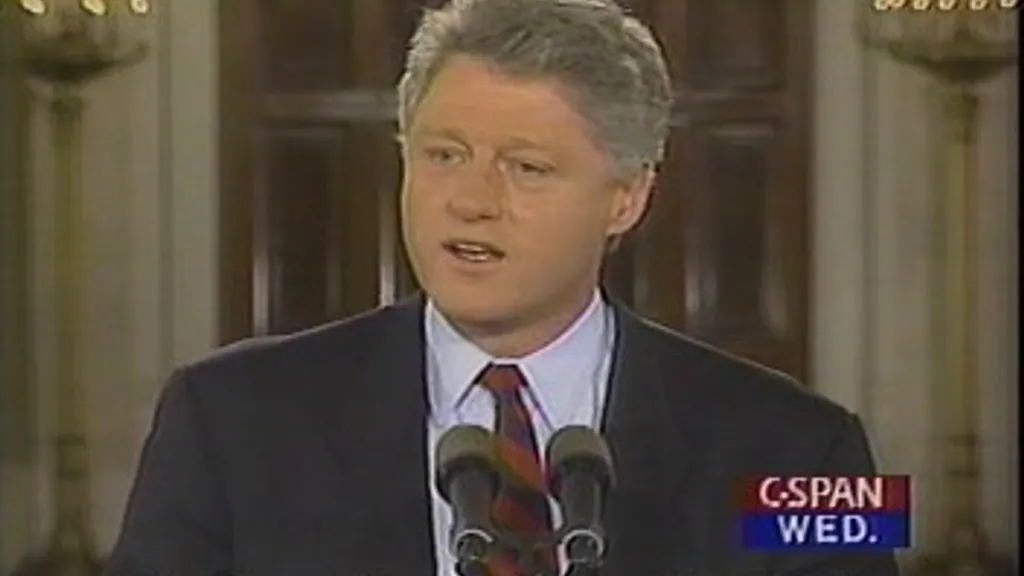
Clinton starts his speech by emphasizing the importance of China and how he is heavily concerned about what goes on there. This is convincing and makes one believe he wants to work in the region to improve what’s happening. He explains how the Chinese aren’t fulfilling their promises about human rights violations, which was a cause for concern for Clinton and his administration. He then talks about the Tiananmen Square massacre and the arrest of peaceful protesters at the engagement. The question becomes how is the President of the United States supposed to impose foreign policy on an incorporating country. One might think the President would crack down on this mistreatment and oppose strict sanctions instead of letting the problem grow. Clinton said, “The question for us now is, given the fact that there has been some progress but that not all the requirements of the executive order were met, how can we best advance the cause of human rights and the other profound interests the United States has in our relationship with China?” (President Clinton Reevaluates Human Rights as an Element of China Policy, May 27, 1994). This means that our relationship with China is fragile because of the gain we get from them. Clinton then decides to renew MFN’s trading status with China, which he says will help build a long-term relationship in making human rights. The goal of this approach is not to isolate China and keep our economic contacts. So Clinton wanted to keep the influx of money from China that benefitted him in the loop instead of opposing harsh sanctions that could leave China to drown and hopefully change their ways. This speech represents how the Chinese government partially controlled the government because of its ability to produce for a lower price. This put money in China and America’s pockets but didn’t focus on the occurring human rights violations.
(President Clinton Reevaluates Human Rights as an Element of China Policy, May 27, 1994

Leave a Reply